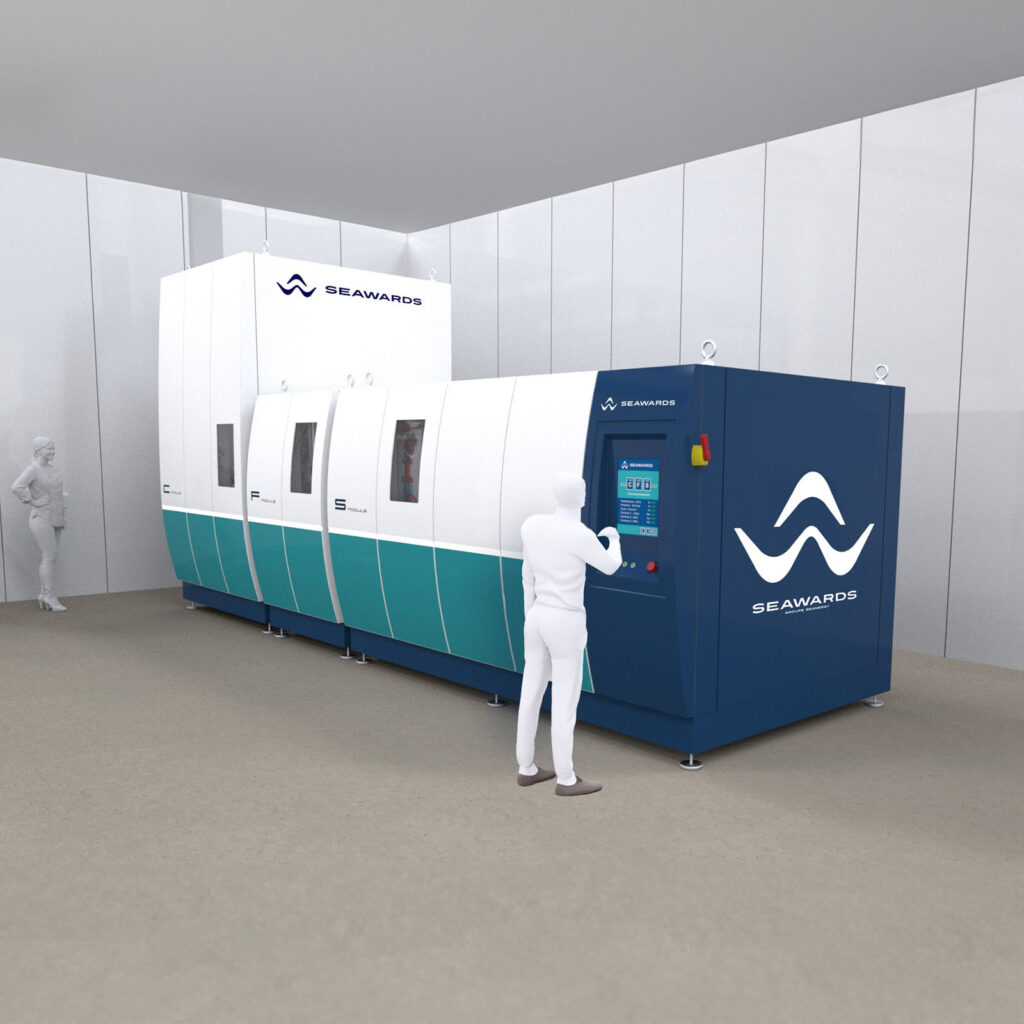
Landscape
STATE OF MATTERS
Existing technologies and their impacts
A PROVEN WATER SHORTAGE
According to consolidated data from UNESCO and UN-Water, the global water crisis now affects several billion people, driven by the combined effects of climate change, population growth, and industrial pressure.
Desalination is insufficient to meet global needs, compounded by current methods that are far too inaccessible: today, the 22,000 desalination plants in operation worldwide, relying overwhelmingly on reverse osmosis, meet less than 17% of global needs. Furthermore, this model has reached an environmental deadlock: these facilities generate over 54 billion cubic meters of pollutant discharges every year (concentrated brines and chemical additives), which are extremely harmful to marine ecosystems.
Large-scale deployment of this technology is becoming complex and unsustainable. There is therefore an absolute need for breakthrough industrial innovation that will make it possible to desalinate for the greatest number of people without threatening the environment.
3 billion People who will face water scarcity by 2030 (Water Risk Atlas).
Of needs covered by current desalination technologies.
Of water on Earth is contained in the oceans.
Of water on Earth is directly accessible to humanity.
Water risk atlas
According to the Water Risk Atlas, 3 billion people will be directly confronted with water scarcity and water stress by 2030 in the face of insufficient renewable natural resources.
DESALINATION STILL SHORT IN SUPPLY
More than half of the seawater desalination is located in the Middle East and Northern Africa. With Saudi Arabia (15.5 %), United Arab Emirates (10.1%), Kuwait (3.7%) being, at once, the largest producers and consumers of these areas of the world.
The East Asia-Pacific and North America regions produce 18.4% and 11.9% of the world’s desalinated water, mainly due to the large capacities of China (7.5%) and the USA (11.2%) respectively.
The large use of desalination in Spain (5.7%) makes up for more that half of the total desalination in Europe totalling (9.2 %). The lowest use of dessalement is in South Asia (3.1%), in Eastern Europe and Central Asia (2.4 %) as in Sub-Saharan Africa (1.9 %), where desalination is limited to small plants dedicated to private or industrials use.
DESALINATION IS CURRENTLY TOO INACCESSIBLE, TOO EXPENSIVE AND TOO POLLUTING
50 millions cubic meters of chemical-loaded brine is discarded in the sea each year. Scale to be a layer 30 cms of this brine covering 152 000 square meters of land.
About reverse osmosis
FOR EVERY LITER OF POTABLE WATER, 1.5 LITER OF CHEMICAL-LOADED BRINE IS REJECTED.
UN report
One of the principal environmental impacts of actual desalination is the raising of the oceans temperature resulting of thermal pollution. The brine rejected, in the ocean, by a reverse osmosis plant, could be as high as 4 degrees higher that the surrounding seawater.
Reverse osmosis’ catastrophic impact on the environment. Analysis in 2 folds :
- High consumption of energy, often fossil fueled, emitting atmospheric pollutants, such as carbon dioxide, sulfate dioxide, nitrogen and particles.
As per example it has been estimated that in Spain, the dessalement systems in place are rejecting 680 grams of CO2 per cubic meter of potable water. A ratio which applied to the production of few millions of cubic meters of drinkable water could result in millions tons of CO2 released in the atmosphere everyday. This contribution to the greenhouse effects can not be neglected at a time of action against global warming.
- Impacts relative to dessalement plant’s rejects are mainly due to the high concentration of salt, and to lesser extent to the presence of chemicals, used for maintenance and efficiency of filters, as the potential raise of sea temperature.
To that effect the Madrid convention provides guidelines and limits values for these rejects of desalination. This results made it mandatory for a study of impact to be conducted for any new plant to be built.
When brine is rejected without dissolution or treatment, it induces a raise of salt concentration in the area where it is rejected. Studies have demonstrated that reject from dessalement plants in the Persian Gulf raised the concentration of salt, locally, from 5 to 10 g/L(elimech 2011).
The main impacts of dessalement on marine ecosystems is rooted in the high salinity of its waste waters. The brine reject into the sea results in the stratifications of layers becoming increasingly more salted towards the sea floor, which reduces the stirring of deep sea water with surface waters.
In some case, depending on local maritime currents, up to 40% of the reject zone could be covered with salt (UNEP 2003).
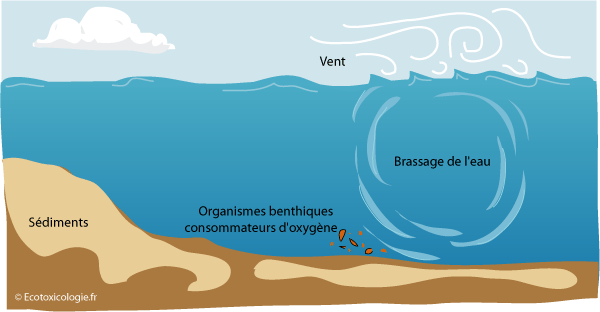
Without brine – © Ecotoxicologie.fr
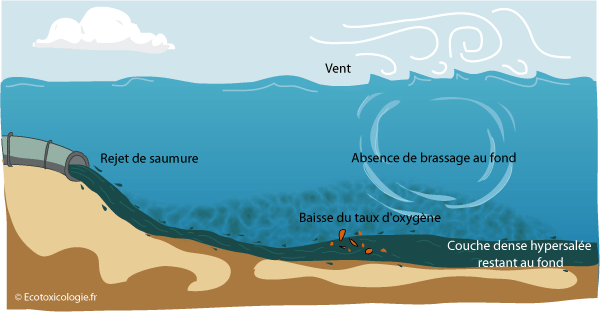
With brine reject – © Ecotoxicologie.fr
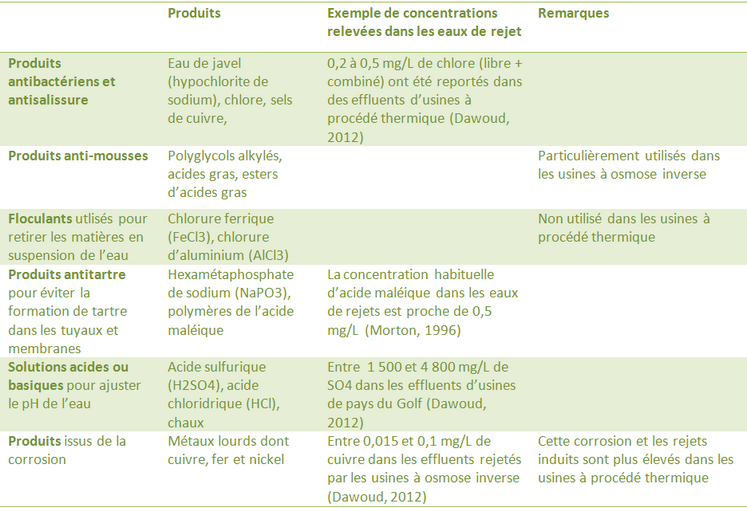
Products found partially in wastewater from dessalement plants – Morton, 1996 et UNEP, 2003 © Ecotoxicologie.fr
Ratio to remember For 1 cubic meter of potable water = 1.5 cubic meter of Brine
The reject of chemical products used along the process of reverse osmosis dessalement are to be found in the brine and water rejected by these plants such as:
- Antibacterials and cleaners: bleach chlorine and copper salt
- Antifungals: polyglycol alkyls, fatty acids
- Antiplaque: sodium hexametaphosphate, maleic acid polymers
- Flocking: ferric chloride, aluminium chloride
- Acidic and basic solutions: chloridric acid, sulfur, lime
- Side products resulting from metal corrosion: heavy metals such as copper, iron and nickel

UNDERSTANDING REVERSE OSMOSIS AND WHY IT IS NOT A SUSTAINABLE SOLUTION
The large majority of desalination units in the world are using the reverse osmosis technology. Its principle is to filter seawater, with the use of high pressure, through a fine and semi permeable membrane.
HIGH ENERGY CONSUMPTION AND REJECTION OF A BRINE THAT DISRUPTS ALONGSIDE CHEMICALS THAT DESTROY THE SUBMARINE FAUNA AND FLORA ECOSYSTEMS’
- Massive reject of chemical brine
- High energy consumption @ 3 KWh/M3
- High investment costs
BRINE DISCHARGE IS LETHAL TO UNDERWATER FLORA AND FAUNA, LEADING TO THE EXTINCTION OF SOME SPECIES
REVERSE OSMOSIS DESALINATION: WHAT IMPACT ON THE ENVIRONMENT?
Desalination, yes, but not at any price… Current reverse osmosis technology impacts the environment in a number of ways, not to mention its energy costs. As narrowed down by Fouad Amraoui, a researcher at Hassan 2 University in Morocco.
Currently, a third of the world’s population is experiencing water stress, and this proportion is set to rise to 2/3 in a few years’ time – so tomorrow! Water, an essential resource, is increasingly coveted, which is why alternative solutions are urgently needed. One such solution is seawater desalination, which is becoming increasingly widespread in the Gulf and Maghreb countries, as illustrated by the proliferation of dedicated plants. This is particularly true of Morocco, which has set up an action plan to install dozens of plants …. What are the drawbacks? Reverse osmosis desalination, the main technology used, is far from neutral for the environment.
An agreement should be reached , stipulating discharge limits for a number of elements (salts, chlorine, temperature, etc.) and the obligation to carry out an impact study (a file examining the environmental consequences of a project) prior to plant construction.
LONG-TERM, MORE COST EFFECTIVE AND LESS POLLUTING SOLUTIONS ARE NEEDED TO ENSURE THE SECTOR'S DEVELOPMENT
SERIAL IMPACTS ….
To the newspaper Médias 24 and hydrology researcher Fouad Amraoui of Morocco’s Hassan 2 University and President of the Association de Recherche Action pour le Développement Durable, discharges from water desalination plants have negative impacts on their environment. These include destruction of the seabed, reduction in plankton biomass and marine biodiversity, increased salinity and heavy metal levels, and threatens the growth, reproduction and survival of macrophytes. The researcher cites a number of negative impacts of wastewater discharge on the marine ecosystem. According to studies for every liter of fresh water produced, 1.5 liters of chemical-laden “brine” are discharged into the environment. High temperatures and high salt concentrations also have a negative effect. Ultimately, water agitation also modifies the local environment, reducing the passage of light and thus the presence of oxygen. This has a direct impact on the condition of corals, fish populations and those living on the ocean floor.
HIGH ENERGY CONSUMPTION
Reverse osmosis technology has an undeniable energy cost. Its emissions of Co2, sulfur and nitrogen oxides, as well as solid particles, run counter to all the challenges of global warming and carbon footprint regulation. Hence the need to adjust the ratio between fresh water and energy. On the one hand, by developing renewable energy alternatives, and on the other, by introducing cutting-edge, disruptive technologies such as cryo-separation.
DESALINATION IS NEEDED
BUT NOT AT A HIGH ENVIRONMENTAL COST
SEAWARDS innovates and offers a new technology to provide water to the largest number with consideration for our environment.
SEAWARDS’ INNOVATION
Cryo-separation™
SEAWARDS desalinates seawater with no pollution, and lower production costs.